
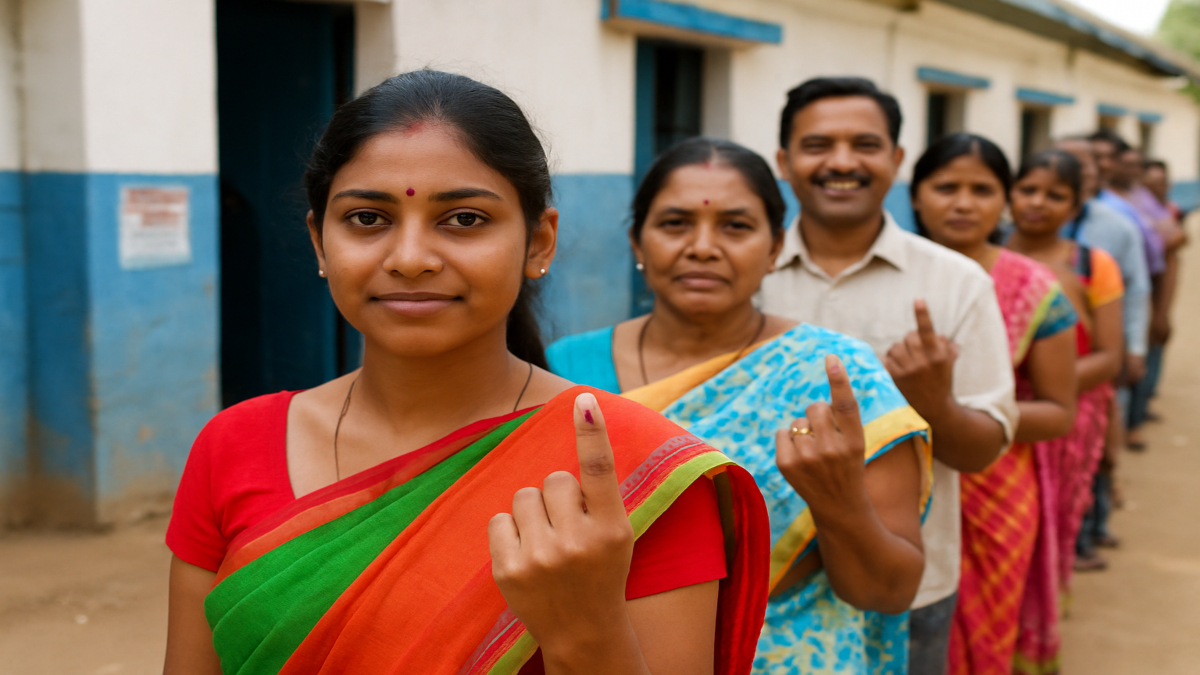
The first phase of the Bihar elections 2025 marks a critical moment in the state’s political landscape. As voters across 121 constituencies in 18 districts prepare to exercise their franchise on November 6. These seats represent half of the 243-member state legislature, with the remaining 122 constituencies to vote in a subsequent phase on November 11. The count for all the seats is scheduled for November 14, making this election a pivotal electoral battle.
NDA vs mahagathbandhan clash
Campaigning ahead of the first phase has been intense. In the final days, major alliances- the ruling Bharatiya Janata Party (BJP) together with the Janata Dal (United) (JD(U)) under the National Democratic Alliance (NDA), and the opposition Rashtriya Janata Dal (RJD)-led Mahagathbandhan (Grand Alliance) mobilised resources, held rallies and sought to sway undecided voters. Meanwhile, the emerging third player, the Jan Suraaj Party (JSP), led by strategist-turned-politician Prashant Kishor, is attempting to carve out space as a non-traditional alternative.
The election is not simply about party politics, but about deep structural issues in Bihar: unemployment, migration of youth to other states, caste and social engineering, law and order, infrastructure deficits and the question of which coalition can address these most credibly. The NDA emphasises its governance record and infrastructural push, while the opposition argues for change and faster delivery of welfare. The entry of JSP adds an element of disruption. These debates were visible in campaign speeches and public meetings ahead of phase one.
Key administrative and procedural preparations have also grabbed attention. A major exercise undertaken by the Election Commission of India (EC) was the Special Intensive Revision (SIR) of electoral rolls, which saw nearly full coverage of electors but also identified lakhs of voters whose names could be deleted due to relocation, duplication or death. Additionally, the EC has ensured that all polling stations across Bihar have fewer than 1,200 electors, making it the first state in India to do so this move is aimed at reducing long queues and improving the voter experience.
In the first phase, polling will run from 7 am to 5 pm, with voters still allowed in queue at 5 p.m. to cast their vote. The list of 121 constituencies includes both general and reserved seats (for Scheduled Castes).
The significance of this first phase lies in its potential to set the tone for the overall election. Success or failure in these key 121 seats could influence momentum, alliances, campaign strategy and psychological advantage ahead of the second phase. Political observers note that the phase serves as a barometer of public mood in some of the more politically sensitive districts: Patna, Darbhanga, Madhepura, Muzaffarpur, Sitamarhi, among others.