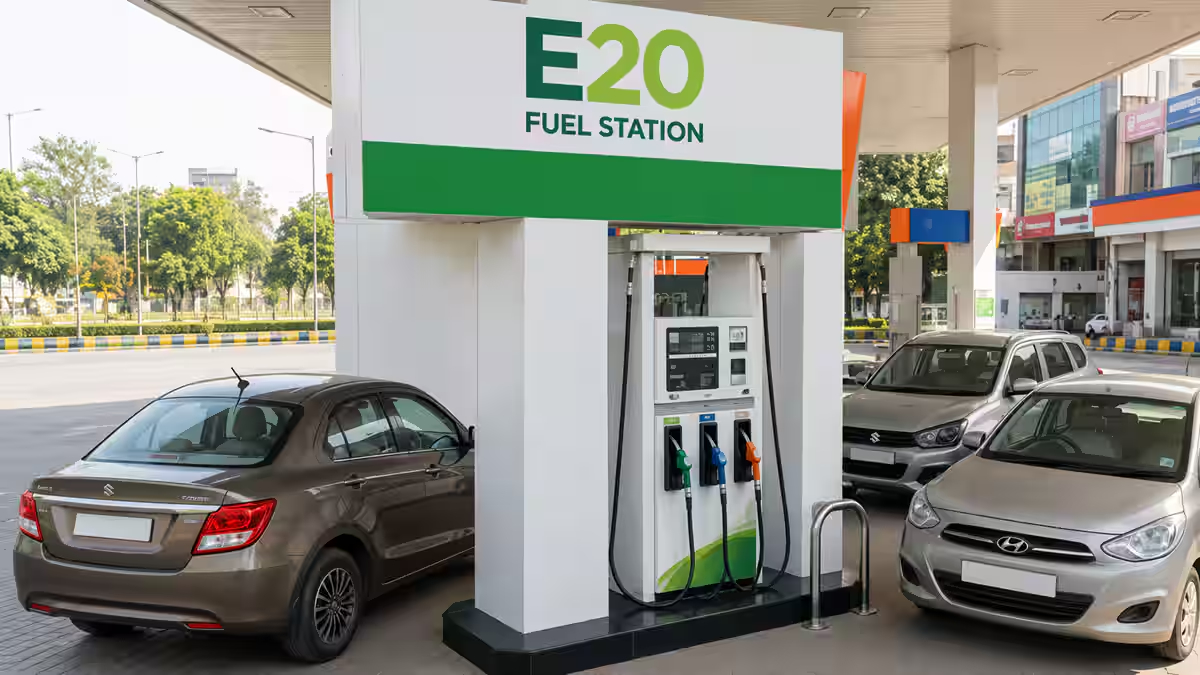
The Indian government has made the nationwide sale of E20 petrol (20% ethanol blended with 80% petrol) mandatory from April 1 as part of its strategy to reduce crude oil imports, improve energy security, lower carbon emissions and support farmers through higher ethanol production. However, the rollout has also sparked debate after many vehicle owners reported a decline in fuel efficiency. Union Road Transport and Highways Minister Nitin Gadkari has said that while some vehicles may experience a 3-5% reduction in mileage, fuel economy should be measured through authorised testing rather than relying solely on dashboard readings.
What is E20 petrol?
E20 is a fuel blend that contains 20% ethanol and 80% petrol. Ethanol is a renewable, plant-based biofuel produced from agricultural sources. Compared with conventional petrol, ethanol burns cleaner and helps reduce greenhouse gas emissions. India has gradually increased ethanol blending over the years from E5 (5% ethanol) to E10 (10% ethanol), and now E20 as part of the government’s long-term clean energy roadmap.
How is ethanol made?
Ethanol is produced by fermenting sugars and starches obtained from agricultural crops. In India, the primary raw materials include:
- Sugarcane juice
- Molasses (a by-product of sugar production)
- Damaged food grains
- Maize (corn)
- Rice and other surplus grains
During production, natural sugars are fermented using yeast, producing alcohol. The alcohol is then distilled and dehydrated to obtain fuel-grade ethanol, which is blended with petrol to produce E20 fuel.
How does E20 affect vehicles?
Most petrol vehicles manufactured in recent years are designed to be compatible with E20 fuel. However, ethanol has different chemical properties than petrol, which can influence vehicle performance. Ethanol contains less energy per litre than petrol. As a result, some drivers may notice a slight reduction in mileage. According to the government, the expected decline in fuel efficiency is generally around 3-5% in E20-compatible vehicles, although real-world performance may vary depending on driving conditions, traffic, maintenance and vehicle condition.
For older vehicles that were not designed for E20, prolonged use may increase wear on rubber seals, fuel hoses and certain engine components if they are not ethanol-resistant.
Advantages of E20 petrol
Reduces Crude Oil Imports- India imports a significant portion of its crude oil. Greater ethanol blending lowers petrol consumption and helps reduce the country’s import bill.
Lower Carbon Emissions- Ethanol burns more cleanly than petrol, helping reduce carbon monoxide and greenhouse gas emissions.
Supports Farmers- Higher demand for ethanol creates an additional market for sugarcane, maize and other crops, increasing farmers’ income opportunities.
Improves Energy Security- Domestic ethanol production reduces dependence on imported fossil fuels and strengthens India’s energy security.
Boosts Rural Economy- The ethanol industry creates employment in agriculture, sugar mills, distilleries and logistics.
Disadvantages of E20 petrol
Lower Fuel Efficiency- Since ethanol has lower energy content than petrol, vehicles may deliver slightly lower mileage.
Compatibility Issues- Older petrol vehicles that are not E20-compatible may experience faster wear of fuel system components over time.
Higher Maintenance Costs- In non-compatible vehicles, ethanol can damage fuel lines, seals and injectors, potentially increasing maintenance expenses.
Seasonal Performance- Ethanol absorbs moisture more easily than petrol, which can affect storage and fuel quality under certain conditions.
Agricultural Dependence- Large-scale ethanol production requires agricultural feedstock, raising concerns about balancing food production with fuel production during years of poor harvest.
Is E20 Safe for your car?
If your vehicle manufacturer has certified the car as E20-compatible, the fuel is generally safe to use. Most new petrol vehicles sold in India since 2023 have been designed or calibrated to run on E20 fuel. Owners of older vehicles should check their owner’s manual or consult the manufacturer before regularly using E20 petrol.
Why is India promoting E20?
India spends billions of dollars every year importing crude oil. By increasing ethanol blending, the government aims to:
- Reduce oil import dependence
- Cut fuel emissions
- Promote renewable energy
- Increase farmers’ income
- Move towards cleaner transportation
The long-term objective is to make India’s transport sector more sustainable while reducing exposure to volatile global crude oil prices.
Which countries use E20 petrol?
Several countries around the world have adopted E20 petrol or are gradually moving towards higher ethanol-blended fuels as part of their clean energy and energy security strategies. Brazil is a global leader in ethanol use, where petrol typically contains 27% ethanol (E27), and many vehicles are flex-fuel models capable of running on much higher ethanol blends. India has recently introduced E20 petrol nationwide to reduce crude oil imports, lower emissions, and support domestic ethanol production. Thailand has offered E20 fuel for years alongside other ethanol blends, while Paraguay and Zimbabwe have also implemented E20 as part of their biofuel programs. In the United States, the most common fuel is E10, though E15 is widely available in many states and E20 or higher blends are used in select fleets and flex-fuel vehicles rather than for general consumers. Most European countries primarily use E5 and E10 petrol, although they continue to explore higher ethanol blends as part of their decarbonisation efforts. The adoption of E20 varies by country depending on vehicle compatibility, ethanol production capacity, government policies, and environmental goals.