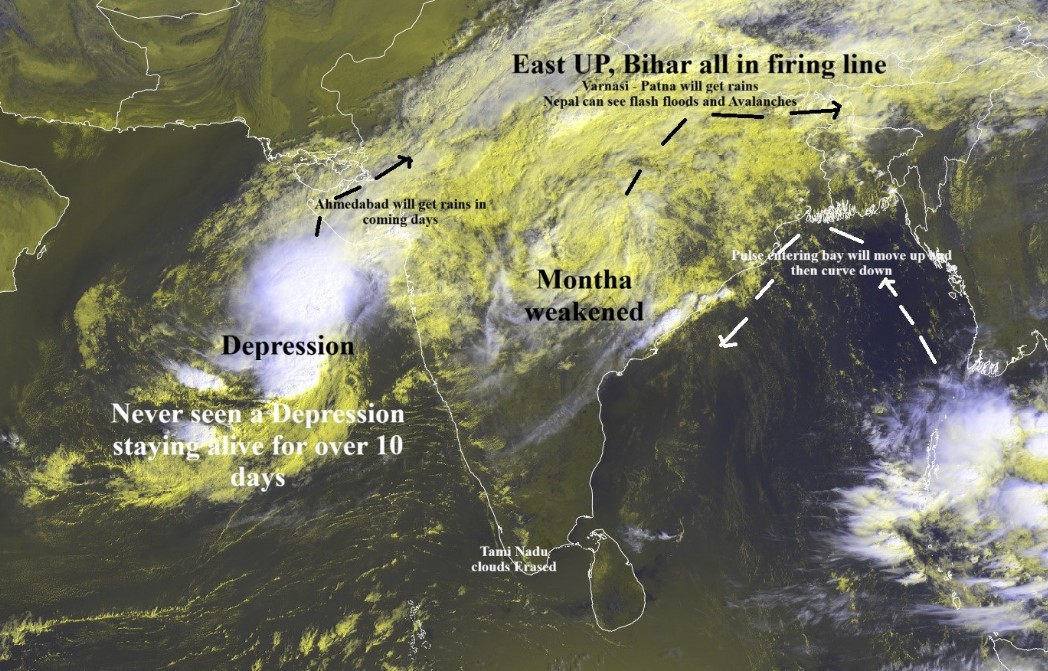
Bihar has been lashed by unusually heavy rainfall on Thursday, with districts like Darbhanga, Supaul, Araria, and Siwan recording over 40 mm to even above 300 mm rain in the span of just a few days, shattering previous records for late October precipitation.
The state capital Patna has also experienced persistent showers, while localised downpours in northern Bihar have led to waterlogging and disruptions in daily life.
Rainfall data: How much has Bihar received?
In the last 24 to 48 hours, several districts in North Bihar have recorded between 30 and 50 mm, with isolated spots like Siwan reportedly witnessing an astonishing 320 mm of rain within a single day earlier this month, a figure over 800% above the seasonal norm.
According to district-wise rainfall data, Darbhanga recorded 46.6 mm and Supaul saw 40.2 mm as of October 29. Areas like Madhepura, Araria, and Saharsa have also observed moderate to heavy spells, causing considerable difficulties for residents.
What’s causing this unseasonal downpour?
Meteorologists attribute Bihar’s current deluge to a rare combination of weather systems. The most immediate trigger is the remnants of Cyclone Montha, which weakened but continued to push moist air from the Bay of Bengal into eastern India, fueling widespread rainfall.
This system, termed a “deep depression,” is presently impacting eastern states with persistent cloud cover and gusty winds, leading to sustained rainfall in Bihar.
Additionally, the India Meteorological Department (IMD) notes that the delay in withdrawal of the southwest monsoon has kept rainfall activity alive in the region, with the Bay of Bengal and Arabian Sea continuing to feed moisture toward Bihar.
Climate experts add global factors like the La Niña phenomenon and Indian Ocean Dipole, both known to intensify monsoon-like conditions, as contributing factors for this extraordinary rainfall in October, a month usually marked by dryness in Bihar.
With more rains forecast for the coming days, authorities have issued yellow and orange alerts across many districts, urging residents to stay cautious of waterlogging, flash floods, and transportation disruptions.